Mastering Real Estate Contract Addendum Essentials

Table of Contents
- Definition and Legal Framework of a Real Estate Contract Addendum
- Core Purpose and Modification Mechanics
- Legal Weight and Enforceability
- Common Scenarios Requiring Addendums
- Comparison: Addendum vs. Amendment vs. Rider
- Key Clauses to Include in a Real Estate Contract Addendum
- Financing Contingency Clause
- Home Inspection Contingency Clause
- Deadline and Compliance Clauses
- Financial Adjustment Clauses
- Procedure for Reviewing Addendum Clauses for Loopholes or Unfair Terms
- Common Mistakes and Risks in Real Estate Contract Addendums
- Top Three Mistakes in Drafting and Signing Addendums
- Risks of Poorly Worded Addendums
- Comparative Analysis of Addendum Failures in High-Pressure Transactions
- Step-by-Step Process for Drafting and Executing a Real Estate Contract Addendum
- Procedural Steps for Drafting an Addendum
- Ensuring Mutual Understanding Before Execution
- Addendums in Specialized Real Estate Scenarios
- Commercial Real Estate Addendums: Leasehold Improvements and Tenant Stipulations
- Short-Term Rental Addendums: Occupancy Limits and Property Use Restrictions
- Foreclosure Sale Addendums: Lender-Specific Clauses and Transaction Modifications
- Tools and Resources for Real Estate Contract Addendums
- Essential Software for Drafting, Reviewing, and Managing Addendums
- State-Specific Legal Resources and Compliance Verification
- Tracking Addendum Versions, Signatures, and Deadlines with Contract Management Software
A real estate contract addendum serves as a critical instrument in modifying or enhancing the terms of a primary agreement, ensuring legal clarity and protecting all parties involved. From financing contingencies to property inspections, these supplementary documents bridge gaps in the original contract while maintaining enforceability under strict legal frameworks. Understanding their purpose, structure, and potential pitfalls is essential for agents, buyers, and sellers navigating complex transactions. This guide explores the foundational principles, key clauses, and procedural best practices to mitigate risks and optimize outcomes in real estate agreements.
The legal landscape of real estate transactions demands precision, particularly when integrating addendums that alter deadlines, financial obligations, or contingencies. Without proper drafting, even minor oversights can lead to costly disputes or voided contracts. This discussion dissects the distinctions between addendums, amendments, and riders, examines high-risk scenarios such as auctions or distressed properties, and provides actionable strategies to draft, review, and execute these documents with confidence. Whether addressing commercial leases, short-term rentals, or co-ownership structures, the principles outlined here ensure compliance and clarity across diverse real estate contexts.
Definition and Legal Framework of a Real Estate Contract Addendum
A real estate contract addendum serves as a legally binding supplement to an existing purchase agreement, clarifying terms, introducing new conditions, or modifying existing provisions without invalidating the original contract. Its primary purpose is to address unforeseen circumstances, resolve ambiguities, or incorporate additional protections for parties involved. Unlike standalone agreements, an addendum maintains the integrity of the primary contract while ensuring compliance with state and federal real estate laws, including the Statute of Frauds, which requires written modifications to real estate transactions.
The legal weight of an addendum derives from its integration into the original contract, making it enforceable as part of the agreement. Courts generally uphold addendums if they are signed by all parties, dated, and clearly referenced in the primary document. However, enforceability hinges on compliance with parol evidence rules, which prohibit oral modifications unless reduced to writing. For instance, a financing contingency addendum may specify loan approval deadlines, while an inspection addendum could outline repair obligations post-discovery of defects.
Core Purpose and Modification Mechanics
An addendum modifies or supplements the original contract by either:The modification process adheres to the mirror image rule, requiring all parties to agree explicitly to changes. Failure to incorporate an addendum into the primary contract may render it unenforceable, as seen in Wood v. Lucy, Lady Duff-Gordon (1917), where oral modifications were invalidated due to lack of written consent.
Legal Weight and Enforceability
The enforceability of an addendum is contingent on three key factors:1. Mutual Assent: All parties must sign the addendum voluntarily, with full understanding of its implications.
2. Integration Clause: The primary contract should include a merger clause (e.g., "This agreement constitutes the entire understanding between the parties"), which may limit reliance on prior negotiations but does not negate addendums if properly executed.
3. Compliance with Statutory Requirements: Addendums must adhere to state-specific real estate laws, such as California’s Civil Code § 1636 (requiring written modifications) or New York’s General Obligations Law § 5-701 (governing contract modifications).
Example: A financing contingency addendum in Texas must comply with the Texas Property Code § 5.008, which mandates clear disclosure of loan conditions to avoid misrepresentation claims.
Common Scenarios Requiring Addendums
Addendums are legally required or strategically used in the following scenarios, each addressing critical risks or uncertainties:-
Financing Contingencies
Addendums specify loan terms, including interest rates, appraisal requirements, and deadlines (e.g., "Buyer has 30 days to secure financing or forfeit the earnest money deposit"). Failure to include such clauses can lead to disputes under RESPA (Real Estate Settlement Procedures Act) if lenders impose undisclosed fees. -
Property Inspection and Repair Agreements
Post-inspection addendums outline repair responsibilities, often using language like:"Seller shall remedy all structural defects identified in the inspection report within 14 days of mutual acceptance, with costs not exceeding $5,000."
Non-compliance may trigger specific performance claims under UCC § 2-709 (if the property is considered "goods") or breach of contract remedies. -
Home Warranty and Title Commitments
Addendums may require sellers to purchase a one-year home warranty or specify exceptions to title insurance (e.g., unrecorded easements). For example, in Florida, Fla. Stat. § 689.25 mandates disclosure of known title defects, often addressed via addendums. -
Contingency Removal
When buyers waive contingencies (e.g., inspection or financing), addendums must include disclaimers to avoid liability for undisclosed defects. Courts in Henningsen v. Bloomfield Motors (1960) upheld such waivers if proven voluntary and informed. -
Leaseback or Occupancy Agreements
Addendums may permit sellers to lease back the property post-sale, with terms governed by landlord-tenant laws (e.g., Illinois’ 735 ILCS 5/9-209 for security deposit requirements).
Comparison: Addendum vs. Amendment vs. Rider
The distinctions between these contract modifications are critical for legal compliance and risk mitigation. Below is a structured comparison:| Feature | Addendum | Amendment | Rider |
|---|---|---|---|
| Definition | A supplementary document that adds, deletes, or clarifies terms in the original contract. | A formal revision that replaces or alters existing terms, often requiring renegotiation of the entire agreement. | A standalone attachment that modifies specific clauses without altering the primary contract’s structure. |
| Use Case |
|
|
|
| Legal Implications | Enforceable if integrated into the original contract and signed by all parties. May override conflicting terms per UCC § 2-209 (if applicable). |
Requires full renegotiation and resubmission for signatures. Amendments to material terms (e.g., price) may reset contingencies in some states. |
Legally binding if referenced in the primary contract. Riders are often used for non-material terms to avoid triggering full amendments. |
| Example Scenario | A buyer requests a 10-day extension for financing approval via an addendum, preserving the original contract’s validity. |
Seller and buyer agree to reduce the purchase price by 5% due to market conditions, necessitating a full amendment. |
A rider specifies that the seller will provide a "seller’s disclosure" form within 48 hours of the offer acceptance. |
| Risk of Misuse | Unsigned or undated addendums may be deemed void. Courts may reject addendums that contradict merger clauses. |
Amendments to essential terms (e.g., property description) without proper documentation can lead to fraudulent inducement claims under Restatement (Second) of Contracts § 164. |
Riders not referenced in the primary contract may be ignored by courts, as seen in In re Marriage of Lizotte (1994), where oral riders were invalidated. |
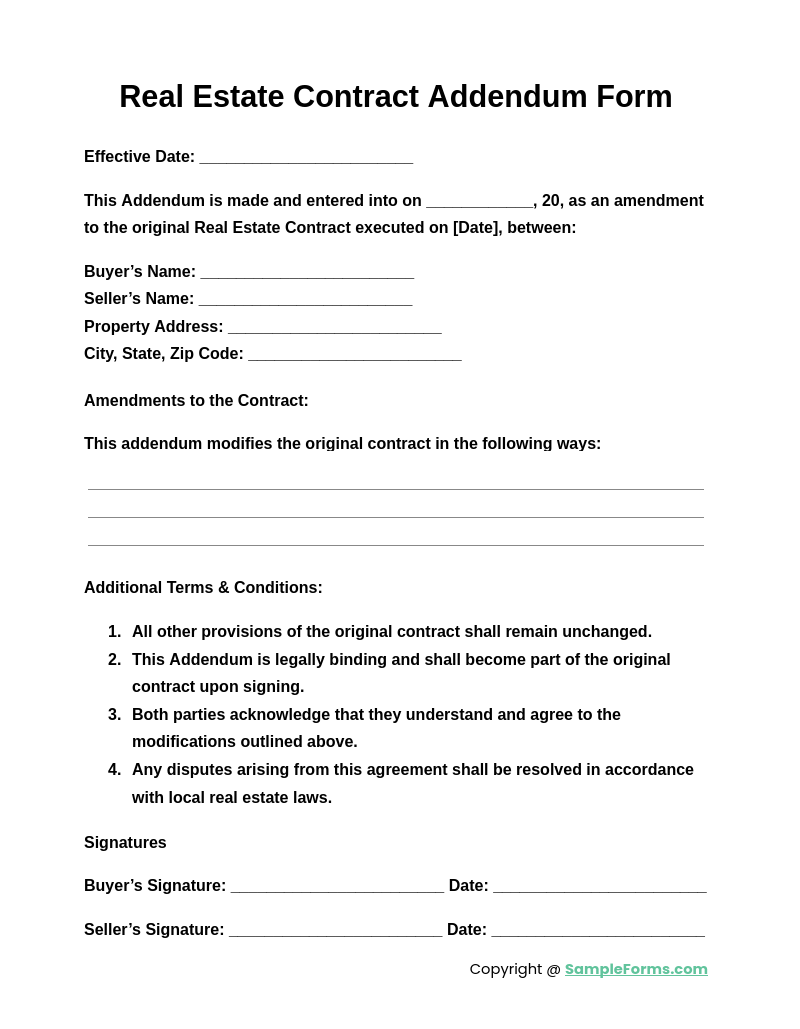
Key Clauses to Include in a Real Estate Contract Addendum
A real estate contract addendum serves as a legally binding amendment to the original purchase agreement, clarifying or modifying terms to protect the interests of all parties involved. The inclusion of critical clauses ensures transparency, mitigates risks, and aligns expectations between buyers, sellers, and their respective agents. Below are the five most essential clauses that should be incorporated into every addendum, structured to address deadlines, contingencies, financial adjustments, and compliance mechanisms.Financing Contingency Clause
The financing contingency clause allows the buyer to withdraw from the contract if they fail to secure approved financing within a specified period. This clause is particularly critical in markets where mortgage approvals are competitive or subject to strict lender requirements. A well-drafted financing contingency should include:Example Draft for Financing Contingency:
"Buyer shall obtain a written commitment for financing from a qualified lender within 30 days of the Effective Date of this Agreement. The financing shall be for at least 80% of the Purchase Price at an interest rate not exceeding 7.5% (fixed). Failure to secure such financing shall result in the immediate termination of this Agreement, and Seller shall retain the Earnest Money Deposit as liquidated damages, unless otherwise agreed in writing."Key Considerations:
Home Inspection Contingency Clause
The home inspection contingency provides the buyer with an opportunity to assess the property’s condition and negotiate repairs or credits based on inspection findings. This clause must define the inspection process, timelines, and consequences of failure to address critical issues.Step-by-Step Process for Negotiating and Incorporating a Home Inspection Contingency:
1. Inspection Timeline:
Example Draft for Home Inspection Contingency:
"Buyer shall have the right to conduct a professional home inspection within 12 days of the Effective Date. If the inspection reveals material defects as defined by applicable state laws, Buyer may require Seller to repair such defects or provide a credit equal to 10% of the Purchase Price. Failure to reach an agreement within 7 days shall terminate this Agreement, and Earnest Money shall be returned to Buyer."Real-Life Case Example:
In a 2022 Texas transaction, a buyer’s inspection revealed a faulty HVAC system costing $12,000 to replace. The seller initially refused, leading to a 5-day mediation period. The parties agreed to a $7,500 credit, allowing the sale to proceed without litigation. Without a clear contingency clause, the buyer risked losing earnest money or pursuing costly legal action.
Deadline and Compliance Clauses
Deadlines in an addendum ensure all parties adhere to contractual obligations within specified timeframes, reducing the risk of delays or disputes. Compliance clauses outline penalties for non-compliance, such as forfeiture of deposits or termination rights.Critical Deadline Clauses to Include:
Example Table: Common Deadline Clauses and Penalties
| Clause Type | Deadline | Penalty for Non-Compliance |
|---|---|---|
| Financing Approval | 30 days from contract date | Forfeiture of earnest money (5–10% of purchase price) |
| Home Inspection | 12 days from contract date | Waiver of inspection contingency; sale proceeds |
| Title Review | 10 days from contract date | Termination of agreement; refund of earnest money |
| Addendum Execution | 48 hours after submission | Nullification of addendum; return to original terms |
Financial Adjustment Clauses
Financial adjustments address modifications to the purchase price, closing costs, or earnest money based on contingencies or market changes. These clauses must be precise to avoid ambiguity in calculations.Essential Financial Adjustments to Address:
Example Draft for Financial Adjustment:
"In the event the appraised value of the Property is less than the Purchase Price, Buyer and Seller shall negotiate in good faith to adjust the Purchase Price or allocate the difference as follows: (1) Seller shall credit Buyer 10% of the appraisal shortfall, or (2) Buyer shall assume the difference with a corresponding reduction in the Purchase Price. Failure to agree shall terminate this Agreement."Common Pitfalls to Avoid:
Procedure for Reviewing Addendum Clauses for Loopholes or Unfair Terms
A systematic review of addendum clauses ensures fairness, legal compliance, and risk mitigation. Below is a step-by-step checklist to identify potential loopholes or unfair terms:1. Clarity and Specificity Audit:
2. Balance of Power Assessment:
3. Contingency Strength Analysis:
4. Penalty and Remedy Review:
Common Mistakes and Risks in Real Estate Contract Addendums
Real estate contract addendums serve as critical amendments to primary agreements, clarifying terms, contingencies, or obligations. However, poorly drafted or overlooked addendums can expose parties to financial losses, legal disputes, or unintended liabilities. The following analysis examines recurring errors, their consequences, and mitigation strategies, supported by case studies and comparative transactional risks. High-pressure scenarios—such as auctions or distressed property sales—exacerbate these pitfalls, necessitating heightened due diligence.Top Three Mistakes in Drafting and Signing Addendums
Errors in addendum preparation often stem from oversight, miscommunication, or failure to anticipate transactional complexities. The following three mistakes are most frequently documented in legal disputes and financial losses:-
Ambiguous or Incomplete Contingency Language
Addendums frequently modify contingencies (e.g., inspection, financing, or appraisal), but vague phrasing can lead to disputes over compliance. For example, an addendum stating "Buyer’s inspection contingency is waived unless defects exceed $5,000" lacks specificity on how "defects" are quantified or verified. In a 2022 California case (Johnson v. Mountain View Properties), a buyer sued after discovering termite damage exceeding $8,000, arguing the addendum’s threshold was unenforceable due to ambiguity. Courts ruled in favor of the seller, but the buyer incurred $12,000 in emergency repairs, highlighting the cost of imprecise drafting.Mitigation Strategy: Define contingencies with measurable criteria (e.g., "structural defects requiring professional repair exceeding $X") and specify deadlines for dispute resolution.
-
Failure to Align Addendums with Primary Contract Terms
Addendums must not contradict the original agreement. In a 2021 Texas auction dispute (El Paso Auction Co. v. Green Valley Investments), a buyer’s addendum extended the closing timeline by 14 days, but the primary contract included an "as-is" clause with a 30-day close. The seller argued the addendum voided the auction’s binding terms, leading to a $250,000 breach-of-contract penalty when the buyer backed out. Courts upheld the primary contract’s precedence, demonstrating how addendums can inadvertently invalidate enforceable terms.Mitigation Strategy: Cross-reference all addendums to the original contract’s section numbers and include a clause explicitly stating compliance with prior terms (e.g., "This addendum supersedes only Sections 4.2 and 5.1 of the Original Agreement").
-
Oral Modifications Without Written Confirmation
Verbal agreements to amend terms are unenforceable in most jurisdictions. A 2020 New York case (Brooklyn Heights Dev. Corp. v. Chen) involved a buyer and seller who verbally agreed to reduce the earnest money deposit after an inspection. The seller later refused to honor the change, citing the lack of a written addendum. The buyer lost the deposit ($75,000) and faced additional legal fees, as courts rejected the oral modification. This underscores the critical role of written documentation in real estate transactions.Mitigation Strategy: Require all modifications—even minor—to be documented via a signed addendum or email with acknowledgment. Use language such as "This email serves as a written amendment to the Original Agreement, effective immediately."
Risks of Poorly Worded Addendums
Poorly drafted addendums introduce legal and financial vulnerabilities, including unintended liabilities, enforcement challenges, and predatory exploitation. The following risks are most prevalent in high-stakes transactions:-
Unintended Financial Liabilities
Addendums may inadvertently expose parties to costs not contemplated in the original agreement. For instance, a 2019 Florida case (Miami Shores Condo Assoc. v. Rodriguez) involved an addendum allowing the seller to defer HOA fee payments until closing. The buyer later discovered the HOA assessed a $30,000 special assessment for structural repairs, which the seller could not cover. The buyer sued for breach of contract, arguing the addendum created an unenforceable financial burden. The court ruled in favor of the buyer, awarding damages plus legal fees, illustrating how addendums can shift unforeseen costs.Risk Mitigation: Include a clause limiting liability for post-closing assessments (e.g., "Seller shall not be liable for HOA fees or assessments arising after the effective date of this addendum").
-
Legal Disputes Over Enforceability
Addendums lacking proper execution (e.g., missing signatures, notary acknowledgments, or counteroffer acceptance) are often deemed void. In a 2021 Arizona dispute (Phoenix Metro Properties v. Lee), an addendum modifying the financing contingency was initialed by the buyer’s agent but not signed by the buyer. The seller argued the addendum was invalid, and the buyer defaulted, losing the $150,000 deposit. Courts sided with the seller, emphasizing the need for full compliance with statutory requirements (A.R.S. § 33-421).Risk Mitigation: Ensure addendums include:
- Full legal names and signatures of all parties.
- Notarization or witness signatures where required by state law.
- A clear acceptance clause (e.g., "This addendum is accepted by all parties as a binding amendment to the Original Agreement").
-
Exploitation in Distressed or Auction Transactions
High-pressure environments (e.g., auctions, foreclosures) increase the risk of predatory addendums. A 2020 Ohio case (Cleveland Auction Group v. Davis) involved a buyer who signed an addendum waiving the inspection contingency after a competitive auction. The property had hidden foundation cracks, leading to a $200,000 repair bill. The buyer sued, but the court upheld the waiver, citing the auction’s "as-is" terms. This case exemplifies how distressed transactions prioritize speed over due diligence, often at the buyer’s expense.Risk Mitigation:
- Engage a real estate attorney to review addendums in auctions or distressed sales.
- Include a "cooling-off period" clause (e.g., "This addendum shall not take effect until 48 hours after signing").
- Avoid waiving contingencies without professional advice, especially in competitive bids.
Comparative Analysis of Addendum Failures in High-Pressure Transactions
High-pressure transactions—such as auctions, foreclosures, and short sales—elevate the risk of addendum-related failures due to time constraints, emotional decision-making, and asymmetric information. The following table compares failure patterns and mitigation strategies:| Transaction Type | Common Addendum Failure Points | Case Study Example | Mitigation Strategy | |||||||||||
|---|---|---|---|---|---|---|---|---|---|---|---|---|---|---|
| Auctions |
|
2019 Texas Auction Dispute (Dallas Property Auctions v. Martinez): A buyer waived the inspection contingency in an auction and later sued after discovering a flooded basement. The court upheld the waiver, awarding the seller $180,000 in damages for breach of contract by the buyer. |
|
|||||||||||
| Foreclosures |
Step-by-Step Process for Drafting and Executing a Real Estate Contract AddendumA real estate contract addendum modifies, clarifies, or supplements the original purchase agreement without replacing it entirely. The drafting and execution process requires precision, compliance with legal standards, and mutual agreement between all parties. This structured approach ensures transparency, mitigates disputes, and guarantees enforceability. Below is a detailed procedural breakdown, including required formalities, communication templates, and methods to confirm understanding before execution.Procedural Steps for Drafting an AddendumThe addendum process begins with an identified need for modification and concludes with legally binding execution. Each step involves specific actions to maintain validity and enforceability.Initial Request and Assessment Key Actions: Drafting the Addendum Template for a Professional Addendum Letter Subject: Proposal for Addendum to [Original Contract Date] – [Property Address] Dear [Recipient’s Name], Pursuant to the Purchase Agreement dated [Original Date] for the property located at [Address], we propose the following modification to the terms as outlined below. This addendum is intended to clarify/amend [specific clause or term] to reflect [rationale for change, e.g., "the results of the recent property inspection"]. Proposed Addendum Language: This Addendum to the Purchase Agreement dated [Original Date] ("Agreement") between [Buyer’s Name] and [Seller’s Name] ("Parties") is effective as of the Agreement’s signing date.Next Steps: We request your review and acceptance of this addendum by [Deadline, typically 3–5 business days]. Should you have any questions or require further clarification, please contact [Your Name/Contact Information]. Failure to respond within the specified timeframe may be construed as acceptance or rejection, per the original agreement’s terms. Legal Disclaimer: Sincerely, Negotiation and Revision Finalization and Signatures Notarization and Recording Ensuring Mutual Understanding Before ExecutionAn addendum’s validity hinges on all parties comprehending its implications. Misunderstandings can lead to breaches or litigation. The following methods confirm clarity:Clarification Methods Follow-Up Protocols Example of a Clarification Follow-Up Email Subject: Follow-Up on Addendum – [Property Address] Dear [Recipient’s Name], Thank you for your initial review of the proposed addendum regarding [specific change]. To ensure full clarity, I’d like to confirm the following points discussed during our call on [Date]: 1. The revised financing contingency now includes a 30-day extension for loan approval, effective immediately. Please reply to this email confirming your understanding of these terms or let me know if further adjustments are needed. Your signed addendum is required by [Deadline] to proceed. Best regards, Decision Points and Actions Flowchart (Text Description) The addendum process can be visualized as a flowchart with the following decision points and actions: 1. Initiation: 2. Drafting Phase: 3. Communication: 4. Negotiation: 5. Execution: 6. Post-Execution: Addendums in Specialized Real Estate ScenariosReal estate transactions vary significantly based on property type, transaction purpose, and stakeholder dynamics. Addendums in specialized scenarios reflect these distinctions by incorporating industry-specific clauses, regulatory compliance requirements, and tailored provisions to mitigate risks unique to commercial leases, short-term rentals, foreclosure sales, and co-ownership structures. Each scenario demands precision in drafting to ensure legal enforceability and alignment with contractual objectives.The structure of addendums in these contexts often diverges from residential purchase agreements, incorporating provisions such as tenant improvement allowances, occupancy restrictions, lender consents, or profit-sharing mechanisms. Below, structured breakdowns address the distinct requirements and clauses for commercial real estate, short-term rentals, foreclosure sales, and co-ownership agreements, emphasizing their operational and legal distinctions. Commercial Real Estate Addendums: Leasehold Improvements and Tenant StipulationsCommercial real estate addendums prioritize tenant-specific obligations and landlord concessions, particularly in lease agreements where improvements, use restrictions, and financial responsibilities are critical. These documents often serve as amendments to base lease terms, clarifying ambiguities or introducing new conditions tied to tenant operations, property modifications, or subleasing rights.Key provisions in commercial addendums include:
"In the event of tenant default, the landlord may terminate the lease with 30 days’ notice and pursue recovery of unpaid rent, improvement costs, and attorney fees through a commercial foreclosure action."
Short-Term Rental Addendums: Occupancy Limits and Property Use RestrictionsShort-term rental (STR) addendums address the unique risks of transient occupancy, including noise complaints, property damage, and zoning violations. These documents typically amend standard lease agreements or purchase contracts to impose restrictions tailored to platforms like Airbnb or VRBO, often requiring landlord or HOA approval.Core provisions include:
"The property shall not be used for commercial purposes, including but not limited to, event hosting, photography shoots, or short-term corporate housing without prior written consent."This clause prevents misuse as a de facto hotel or Airbnb business, which may violate residential zoning laws.
"The tenant shall comply with all platform-specific rules (e.g., Airbnb’s Host Guarantee Program) and provide proof of registration within 14 days of lease commencement."
Foreclosure Sale Addendums: Lender-Specific Clauses and Transaction ModificationsForeclosure sale addendums differ from traditional transactions by incorporating lender priorities, statutory timelines, and post-sale obligations. These documents often amend purchase agreements to address deficiencies in title, financing contingencies, or lender-approved repairs, while adhering to state-specific foreclosure laws (e.g., RESPA in the U.S. or Prevention of Mortgage Fraud Act).Critical clauses include:
|
Leave a Comment
Comments are moderated before appearing. The data you submit is processed according to the Privacy Policy of www.linuxunplugged.com.