Fahrenheit To Celsius Formula Explained With Practical Applications

Table of Contents
- Mathematical Foundation of the Fahrenheit-to-Celsius Conversion Formula
- Historical Context and Scale Design Principles
- Derivation of the Conversion Formula from Fixed Points
- Comparison of Fahrenheit and Celsius Scale Characteristics
- Practical Applications and Real-World Use Cases of Fahrenheit-to-Celsius Conversion
- Industries and Professions Requiring Temperature Conversion
- Digital Thermometers and Dual-Scale Weather Reports
- Dual-scale temperature display (Fahrenheit and Celsius)
- Common Household Scenarios for Temperature Conversion
- Consequences of Conversion Errors in Critical Applications
- Algorithmic and Programmatic Implementations of Fahrenheit-to-Celsius Conversion
- Pseudocode for Conversion with Input Validation
- Memory-Efficient Methods for Resource-Constrained Environments
- Integration with Larger Systems: JSON Response Structures
- Debugging Software Modules for Incorrect Conversions
- Educational Tools and Interactive Learning for Fahrenheit-to-Celsius Conversion
- Command-Line Quiz for Randomized Conversion Practice
- Designing a Physical Analog Conversion Tool
- Pedagogical Strategies by Educational Level
- Animated Illustration: Visualizing Fahrenheit-to-Celsius Relationship
The conversion between Fahrenheit and Celsius remains a fundamental skill across scientific, industrial, and everyday contexts, bridging historical temperature scales with modern precision. Originating from distinct scientific traditions, these scales—rooted in the work of Gabriel Fahrenheit and Anders Celsius—serve as critical benchmarks in fields ranging from meteorology to medical diagnostics. Understanding the mathematical underpinnings of their relationship not only resolves practical challenges but also underscores the importance of accuracy in temperature-dependent processes. This discussion explores the derivation of the conversion formula, its real-world applications, and algorithmic implementations to ensure seamless integration into technical and educational frameworks.
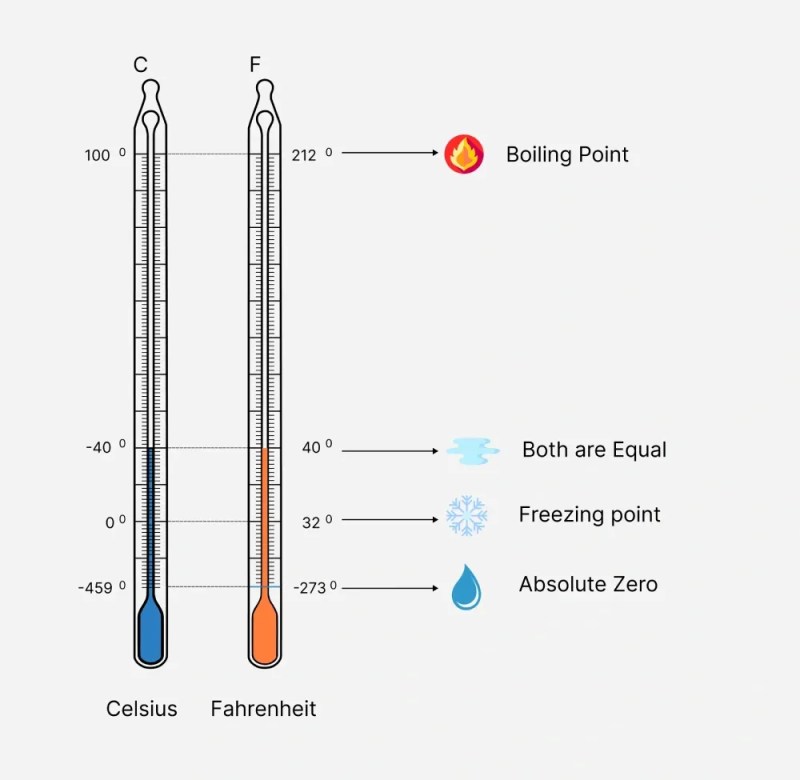
The formula `(C = (F - 32) 5/9)` transcends mere arithmetic; it reflects the structural differences between two scales where water freezes at 32°F (0°C) and boils at 212°F (100°C), with Fahrenheit’s finer granularity demanding proportional adjustments. Beyond theoretical clarity, its utility spans from adjusting oven settings in culinary arts to calibrating aerospace systems, where even marginal errors can have cascading consequences. By examining historical context, practical use cases, and programmatic solutions, this analysis equips professionals and learners with the tools to navigate conversions confidently while mitigating risks associated with miscalculations.
Mathematical Foundation of the Fahrenheit-to-Celsius Conversion Formula
The conversion between Fahrenheit (°F) and Celsius (°C) scales relies on a precise mathematical relationship derived from their distinct historical origins and fixed reference points. The Fahrenheit scale, proposed by Daniel Gabriel Fahrenheit in 1724, was originally calibrated using a mixture of ice, water, and ammonium chloride as the zero point (0°F), with 32°F assigned to the freezing point of water and 212°F to its boiling point at standard atmospheric pressure. In contrast, the Celsius scale, introduced by Anders Celsius in 1742, defined the freezing point of water as 0°C and the boiling point as 100°C, creating a 100-unit interval between these fixed points. These differences in scale design—including the choice of reference temperatures and unit increments—directly influence the conversion formula, which accounts for both the offset (difference in zero points) and the proportional scaling of the two systems.
Historical Context and Scale Design Principles
The development of temperature scales was motivated by the need for standardized measurements in scientific and industrial applications. Fahrenheit’s scale was initially based on empirical observations, including human body temperature (later standardized at 98.6°F) and the freezing/melting behavior of water-ammonia mixtures. Celsius, however, adopted a more intuitive approach by anchoring his scale to the physical properties of water, which remains the most widely referenced substance for temperature calibration. The key divergence between the scales lies in their fixed points and unit increments:
This structural difference necessitates a conversion formula that adjusts for both the offset (32°F difference in freezing points) and the scaling factor (5/9 ratio derived from 180°F / 100°C). The formula’s derivation ensures thermodynamic consistency while accommodating the practical needs of global scientific and meteorological communities.
Derivation of the Conversion Formula from Fixed Points
The conversion between Fahrenheit and Celsius is derived using two fixed reference points: the freezing and boiling points of water at standard pressure (1 atm). These points serve as anchor values to establish a linear relationship between the scales.1. Establishing the Linear Relationship
A linear equation of the form \( C = mF + b \) is used, where:
2. Calculating the Slope (\( m \))
The slope is determined by the ratio of the temperature intervals between the freezing and boiling points:
\[
m = \frac{\text{Celsius interval}}{\text{Fahrenheit interval}} = \frac{100°C - 0°C}{212°F - 32°F} = \frac{100}{180} = \frac{5}{9}
\]
This indicates that a 1°F change corresponds to a \( \frac{5}{9} \)°C change.
3. Determining the Intercept (\( b \))
Using the freezing point of water (32°F = 0°C):
\[
0 = \frac{5}{9} \times 32 + b \implies b = -\frac{160}{9}
\]
Substituting \( b \) into the equation yields:
\[
C = \frac{5}{9}(F - 32)
\]
The subtraction of 32 adjusts for the offset between the scales’ zero points.
4. Rearranging for Fahrenheit-to-Celsius and Vice Versa
\[
F = \left( C \times \frac{9}{5} \right) + 32
\]
Here, \( \frac{9}{5} \) scales the Celsius value to match the larger Fahrenheit increment, and +32 adjusts the zero point.
Key Operations in the Formula:
Subtraction (F - 32): Aligns the Fahrenheit scale’s zero point with Celsius. Multiplication by \( \frac{5}{9} \): Rescales the temperature difference to match the Celsius interval. Addition (+32): Reverses the initial offset when converting back to Fahrenheit.
Comparison of Fahrenheit and Celsius Scale Characteristics
The following table summarizes the fundamental differences between the two temperature scales, emphasizing their fixed points and unit increments:| Scale Name | Freezing Point of Water | Boiling Point of Water | Scale Increment |
|---|---|---|---|
| Fahrenheit (°F) | 32°F | 212°F | 180-degree interval (212 − 32) |
| Celsius (°C) | 0°C | 100°C | 100-degree interval (100 − 0) |
The table highlights how the offset (32°F difference in freezing points) and scaling factor (\( \frac{5}{9} \)) are critical to the conversion process. The Fahrenheit scale’s finer granularity (smaller increments for perceived temperature changes) reflects its historical use in regions where precise sub-degree measurements were valuable, such as in early meteorology and medicine. Conversely, the Celsius scale’s simplicity aligns with its adoption in scientific contexts, where the 100-degree interval facilitates easier calculations and comparisons.
Practical Applications and Real-World Use Cases of Fahrenheit-to-Celsius Conversion
The conversion between Fahrenheit and Celsius extends beyond theoretical mathematics, serving as a critical operational tool across diverse industries and everyday scenarios. Precision in temperature measurement ensures safety, efficiency, and compliance with international standards, particularly in fields where environmental or physiological conditions directly influence outcomes. Errors in conversion can lead to costly mistakes, from compromised food safety in culinary arts to critical failures in scientific research. Below, industries and professions reliant on accurate temperature scaling are examined, alongside common household applications and the technical implementation of dual-scale displays.Industries and Professions Requiring Temperature Conversion
Temperature conversion is indispensable in sectors where global collaboration, regulatory adherence, or environmental monitoring demands consistency. In meteorology, for instance, weather forecasts must accommodate audiences in regions using either scale, with discrepancies risking misinterpretation of extreme conditions (e.g., heatwaves or frost warnings). The aviation industry relies on Celsius for aircraft performance metrics, while pilots and ground crews in the U.S. may reference Fahrenheit for engine oil temperatures, necessitating real-time conversion to avoid mechanical stress or failure.In medicine and pharmaceuticals, body temperature monitoring and drug storage require Celsius, yet some international guidelines or patient records may use Fahrenheit, creating potential for dosage errors if conversions are mishandled. Scientific research, particularly in chemistry and physics, often defaults to Celsius for standard units (e.g., Kelvin conversions), but collaborative studies with U.S.-based partners may involve Fahrenheit data, complicating data integration. Cooking and food safety present another critical domain: recipes from Europe or Asia typically use Celsius, while U.S. appliances default to Fahrenheit, with even a 5°C miscalculation risking undercooked meat or overbaked desserts.
Digital Thermometers and Dual-Scale Weather Reports
Modern digital thermometers and weather applications frequently display temperatures in both Fahrenheit and Celsius to cater to global audiences. This dual-scale presentation is achieved through embedded conversion algorithms that dynamically adjust based on user preferences or regional settings. For example, a smart thermostat may show indoor temperature in Celsius while outdoor conditions appear in Fahrenheit for U.S. users accessing international weather feeds.Below is a plaintext code snippet simulating a dual-scale terminal display in Python, demonstrating how a program might render temperatures in both units with rounded precision:
```
Dual-scale temperature display (Fahrenheit and Celsius)
def display_dual_scale(temp_c):temp_f = (temp_c 9/5) + 32
print(f"Temperature: {temp_c:.1f}°C | {temp_f:.1f}°F")
# Example usage
display_dual_scale(25.0) # Output: 25.0°C | 77.0°F
display_dual_scale(100.0) # Output: 100.0°C | 212.0°F
```
This approach ensures clarity for users transitioning between regions or interpreting data from diverse sources. Weather APIs, such as those from the National Oceanic and Atmospheric Administration (NOAA) or European Centre for Medium-Range Weather Forecasts (ECMWF), often provide raw data in Kelvin, which must be converted to user-selected scales for public consumption.
Common Household Scenarios for Temperature Conversion
Everyday tasks frequently involve temperature conversion, particularly when navigating recipes, travel, or home maintenance. Below are scenarios where accurate conversions are essential:-
Adjusting Oven Temperatures for Recipes
European or Asian recipes often specify oven temperatures in Celsius (e.g., 180°C for baking), while U.S. appliances default to Fahrenheit. A miscalculation—such as setting an oven to 350°F (equivalent to 175°C) instead of the required 375°F (190°C)—can result in undercooked dishes or uneven baking. -
Interpreting International Weather Forecasts
Travelers or expatriates relying on global weather apps (e.g., AccuWeather, Weather.com) must convert between scales to assess suitability for outdoor activities. For instance, a 20°C forecast in Paris translates to 68°F, which may feel mild to a U.S. resident accustomed to 75°F (24°C) as "warm." -
Calibrating Home Appliances
Refrigerators or freezers purchased abroad may display temperatures in Celsius. Incorrect settings—such as freezing at -18°C (0°F) instead of the recommended -20°C (-4°F)—can lead to food spoilage or appliance malfunctions. -
Medical Thermometers and Childcare
Pediatricians often record fever readings in Celsius, but parents in Fahrenheit-using regions must convert values (e.g., 38°C = 100.4°F) to assess whether a child’s temperature exceeds safe thresholds. -
HVAC System Maintenance
Heating, ventilation, and air conditioning (HVAC) technicians may encounter thermostats calibrated in Celsius during service calls, requiring conversions to diagnose issues or set optimal temperatures for energy efficiency.
Consequences of Conversion Errors in Critical Applications
A pharmaceutical manufacturer in Germany received a shipment of insulin vials labeled for storage at "2–8°C." Assuming the Fahrenheit scale due to a misconfigured inventory system, the facility stored the vials at 36–46°F (2–8°C incorrectly interpreted as 36–46°F). While the actual temperature range was correct, the confusion delayed corrective action when a batch of vials was exposed to 77°F (25°C) for 24 hours—well above the safe limit. The error led to a recall, financial losses exceeding €500,000, and reputational damage, underscoring how even minor scale ambiguities can escalate into systemic failures.In industrial settings, a steel mill in China relied on Fahrenheit-based temperature probes for heat treatment processes. When a technician entered a target temperature of 1500°F (815°C) as 1500°C, the furnace overheated, warping a critical batch of alloy components. The miscalculation cost $250,000 in scrap metal and required emergency shutdowns, highlighting the irreversible consequences of scale-related oversights in high-temperature manufacturing.
Algorithmic and Programmatic Implementations of Fahrenheit-to-Celsius Conversion
The conversion between Fahrenheit and Celsius is a fundamental operation in scientific computing, embedded systems, and data-driven applications. Algorithmic implementations must account for precision, edge cases (e.g., absolute zero at −459.67°F or −273.15°C), and resource constraints in environments with limited memory or processing power. This section explores pseudocode for robust implementations, memory-efficient techniques, system integration via standardized data formats, and debugging methodologies for ensuring accuracy in software modules.Pseudocode for Conversion with Input Validation
Implementing the conversion formula in programming languages requires handling edge cases, such as temperatures below absolute zero, which are physically impossible. Below are pseudocode examples for Python and JavaScript, incorporating input validation to reject invalid values and ensure numerical stability.Python Implementation
def fahrenheit_to_celsius(fahrenheit):
"""
Converts a temperature from Fahrenheit to Celsius with input validation.
Args:
fahrenheit (float): Temperature in Fahrenheit.
Returns:
float: Temperature in Celsius, or None if input is invalid.
Raises:
ValueError: If input is below absolute zero (−459.67°F).
"""
ABSOLUTE_ZERO_FAHRENHEIT = -459.67
if not isinstance(fahrenheit, (int, float)):
return None
if fahrenheit < ABSOLUTE_ZERO_FAHRENHEIT:
raise ValueError(f"Temperature cannot be below absolute zero: {fahrenheit}°F")
celsius = (fahrenheit - 32) 5/9
return round(celsius, 2) # Round to 2 decimal places for readability
JavaScript Implementation
/
Converts a temperature from Fahrenheit to Celsius with input validation.
@param {number} fahrenheit - Temperature in Fahrenheit.
@returns {number|null} Temperature in Celsius, or null if input is invalid.
@throws {Error} If input is below absolute zero (−459.67°F).
*/
function fahrenheitToCelsius(fahrenheit) {
const ABSOLUTE_ZERO_FAHRENHEIT = -459.67;
if (typeof fahrenheit !== 'number' || isNaN(fahrenheit)) {
return null;
}
if (fahrenheit < ABSOLUTE_ZERO_FAHRENHEIT) {
throw new Error(`Temperature cannot be below absolute zero: ${fahrenheit}°F`);
}
const celsius = (fahrenheit - 32) (5 / 9);
return parseFloat(celsius.toFixed(2)); // Round to 2 decimal places
}
Key Validation Rules
Memory-Efficient Methods for Resource-Constrained Environments
In embedded systems or IoT devices, memory and computational resources are often limited. Optimizing the conversion process involves trade-offs between accuracy, speed, and storage efficiency. Two primary approaches are lookup tables and bitwise arithmetic optimizations.Lookup Tables for Fixed-Precision Conversions
Lookup tables precompute Celsius values for a discrete range of Fahrenheit inputs, reducing runtime calculations. This method is ideal for systems with constrained CPUs but sufficient flash memory.
Example: 8-Bit Lookup Table for 0°F to 255°F
// Precomputed table for Fahrenheit to Celsius (0°F to 255°F, 1°F increments).
const uint8_t fahrenheit_to_celsius_table[256] = {
[0] = -18, [1] = -17, ..., [255] = 124 // Simplified; actual values use (F-32)*5/9
};
uint8_t convert_f_to_c(uint8_t fahrenheit) {
if (fahrenheit > 255) return 0; // Clamp to table bounds
return fahrenheit_to_celsius_table[fahrenheit];
}
Trade-offs:
Bitwise Arithmetic for Integer-Only Systems
For systems without floating-point units (e.g., microcontrollers), integer arithmetic can approximate the conversion using fixed-point scaling.
Example: Fixed-Point Conversion (Q1.15 Format)
// Q1.15: 16-bit integer represents 1.15 fixed-point (e.g., 0x1000 = 1.0).
int16_t fahrenheit_to_celsius_fixed(int16_t f) {
int16_t c = ((f - 32) 5) >> 1; // Multiply by 5, divide by 9 (approximation)
return c;
}
Key Adjustments:
Integration with Larger Systems: JSON Response Structures
Temperature conversion is often part of larger data pipelines, such as weather APIs or IoT sensor networks. Standardized JSON responses ensure interoperability between systems. Below is an example structure for a weather data API endpoint returning both Fahrenheit and Celsius values.Example JSON Response for Weather Data
{
"metadata": {
"timestamp": "2023-11-15T14:30:00Z",
"location": {
"city": "New York",
"coordinates": { "latitude": 40.7128, "longitude": -74.0060 }
},
"source": "NOAA Global Forecast System"
},
"temperature": {
"value": 68.5,
"unit": "fahrenheit",
"converted": {
"celsius": 20.28,
"kelvin": 293.43,
"validation": {
"is_absolute_zero": false,
"is_physically_plausible": true
}
}
},
"conditions": {
"description": "Partly Cloudy",
"humidity": 65,
"wind_speed": { "mph": 12.3, "kph": 19.8 }
}
}
Key Fields:
Use Case in IoT Sensor Networks
In a low-power sensor node, the JSON payload might be minimized:
{
"sensor_id": "temp-sensor-001",
"timestamp": "2023-11-15T14:30:00Z",
"temp_f": 68.5,
"temp_c": 20.28,
"status": "active"
}
Optimizations:
Debugging Software Modules for Incorrect Conversions
Debugging temperature conversion modules requires systematic verification of logical errors, input/output mismatches, and environmental factors. Below is a step-by-step procedure to identify and resolve issues.Step 1: Reproduce the Error with Known Values
Test the module with boundary conditions and edge cases:
Example Test Cases
| Fahrenheit (°F) |
Educational Tools and Interactive Learning for Fahrenheit-to-Celsius Conversion
The mastery of temperature conversion between Fahrenheit and Celsius extends beyond theoretical understanding; it requires interactive engagement to solidify comprehension across diverse learning styles. Educational tools—both digital and analog—bridge the gap between abstract formulas and practical application, catering to visual, kinesthetic, and analytical learners. Below are structured approaches to integrate interactive and tactile learning into teaching the Fahrenheit-to-Celsius conversion formula, ensuring accessibility and retention at all educational levels.
Command-Line Quiz for Randomized Conversion Practice
A scripted command-line quiz provides an immediate, low-barrier method for reinforcing conversion skills through repetition and feedback. The tool generates random Fahrenheit values, prompts the user for Celsius equivalents, and evaluates responses with real-time scoring. Below is a Python-based pseudocode template for implementation, designed for clarity and adaptability.
Importance of Randomized Practice
Randomized quizzes eliminate memorization of specific examples, fostering adaptability to unseen values. Feedback mechanisms (e.g., "Correct! 98.6°F = 37°C" or "Try again: 212°F = 100°C") reinforce correct understanding while addressing misconceptions.
Script Structure
import random
def fahrenheit_to_celsius(f):
return (f - 32) 5/9
def quiz():
score = 0
questions = 5
for _ in range(questions):
f_temp = random.randint(-50, 120) # Range covers typical learning scenarios
user_input = float(input(f"Convert {f_temp}°F to Celsius: "))
correct = round(fahrenheit_to_celsius(f_temp), 1)
if abs(user_input - correct) < 0.1: # Tolerance for floating-point precision
print(f"Correct! {f_temp}°F = {correct}°C")
score += 1
else:
print(f"Try again: {f_temp}°F = {correct}°C")
print(f"Your score: {score}/{questions}")
quiz()
Enhancements for Pedagogical Value
Designing a Physical Analog Conversion Tool
Analog tools like slide rules or protractors offer tactile, device-free methods for approximating conversions, ideal for classrooms without digital resources. Below are specifications for a Fahrenheit-to-Celsius slide rule, scalable for classroom or individual use.Material Requirements
Scaling and Construction Steps
1. Scale Mapping:
2. Protractor Adaptation:
3. Precision Adjustments:
Educational Integration
Pedagogical Strategies by Educational Level
The Fahrenheit-to-Celsius formula’s complexity varies by grade level, requiring tailored teaching methods to align with cognitive development. Below is a table outlining strategies for elementary arithmetic through calculus, emphasizing hands-on and conceptual approaches.| Grade Level | Teaching Method | Example Activity |
|---|---|---|
| Elementary (Grades 3–5) |
|
Activity: "Temperature Bingo" – Students mark off conversions (e.g., 32°F, 98.6°F) on bingo cards as the teacher calls Celsius equivalents. |
| Middle School (Grades 6–8) |
|
Activity: "Scale War" – Groups design posters comparing Fahrenheit and Celsius using graphs, memes, or infographics. |
| High School (Grades 9–12) |
|
Activity: "Temperature Debate" – Students argue whether Fahrenheit or Celsius is more intuitive for specific contexts (e.g., science vs. daily life). |
| Calculus/Advanced Math |
|
Activity: "Scale Optimization" – Students derive a hypothetical "optimal" temperature scale by minimizing conversion complexity. |
Animated Illustration: Visualizing Fahrenheit-to-Celsius Relationship
An animated graph dynamically demonstrates the linear relationship between Fahrenheit and Celsius, using color, motion, and labeling to clarify the conversion process. Below is a detailed descriptionMastering the Fahrenheit-to-Celsius conversion formula is more than a technical exercise—it is a gateway to precision in diverse disciplines. From the kitchen to the laboratory, the ability to translate between these scales ensures consistency, safety, and efficiency in operations where temperature plays a pivotal role. Whether through manual calculations, embedded systems, or interactive learning tools, the principles outlined here provide a robust foundation for both professionals and educators. As technology evolves, the demand for accurate temperature management will only grow, reinforcing the enduring relevance of this fundamental conversion process in an interconnected world.
Leave a Comment
Comments are moderated before appearing. The data you submit is processed according to the Privacy Policy of www.linuxunplugged.com.