| Time Post-Surgery |
0–6 months: Focus on inflammation control, ROM, and basic strength.
6–9 months: Progressive loading, functional movement patterns. |
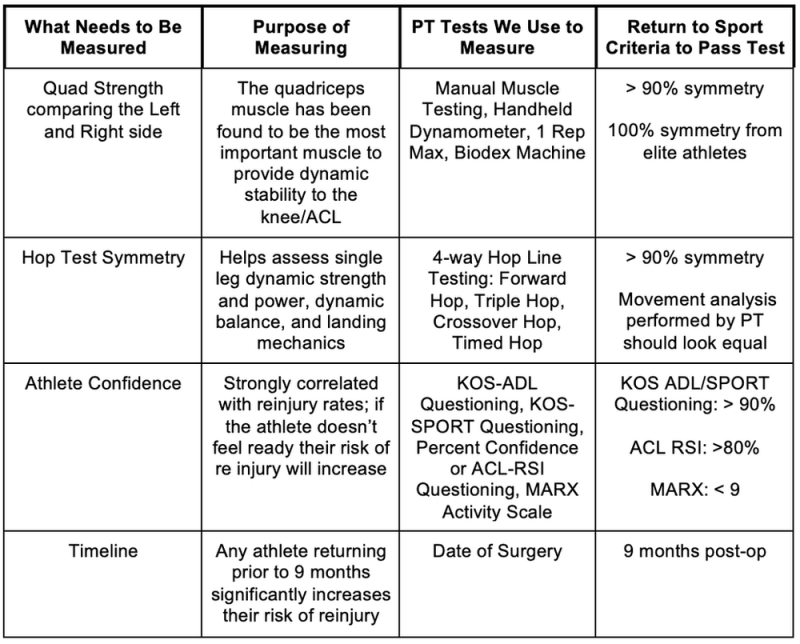
9–12 months+: Sport-specific testing begins only after meeting ≥90% strength symmetry and pain-free functional tasks.
Full RTS clearance typically 12–18 months post-surgery. |
Graft remodeling and CNS adaptation require >9 months for mechanical stability. Early RTS (<9 months) increases reinjury
Return-to-sport (RTS) testing for anterior cruciate ligament (ACL) rehabilitation requires a structured, evidence-based approach to ensure athletes regain functional capacity while minimizing reinjury risk. Core assessment tools integrate functional performance, psychological readiness, and sport-specific demands to provide a comprehensive evaluation. These tests are categorized based on their primary objectives—whether assessing physical capability, mental preparedness, or sport-specific skills—to guide clinicians in designing individualized rehabilitation protocols.The selection of assessment tools depends on the athlete’s sport, position, and rehabilitation phase. Standardized tests provide objective metrics, while sport-specific drills simulate real-game scenarios, offering a more ecologically valid evaluation. Instrumented assessments further enhance precision by quantifying biomechanical and neuromuscular deficits that may not be apparent in subjective evaluations. Below, the most widely adopted protocols are categorized, followed by detailed descriptions of key tests and their integration into customized batteries.
Categorization of Return-to-Sport Tests
Return-to-sport tests are systematically organized into three primary categories to address distinct aspects of athletic performance and injury risk. Functional performance tests evaluate lower-limb symmetry, strength, and dynamic stability, while psychological readiness assessments focus on cognitive and emotional factors influencing decision-making under pressure. Specialized sport-specific drills replicate the demands of high-speed, pivoting, or cutting movements inherent to sports like soccer, basketball, or skiing.The integration of these categories ensures a holistic evaluation, where physical readiness is validated by sport-specific competence and psychological resilience. For example, an elite soccer player may demonstrate symmetric hop distances but fail under high-speed agility demands or psychological stress, highlighting the necessity of a multifaceted approach.
Functional performance tests form the foundation of ACL RTS evaluations, as they quantify deficits in lower-limb strength, power, and neuromuscular control. Among these, the Single-Leg Hop Test (SLHT) and Triple Hop Test (THT) are widely used due to their simplicity, reliability, and ability to detect asymmetries between the involved and uninvolved limbs.#### Single-Leg Hop Test (SLHT)
The SLHT assesses an athlete’s ability to generate force and maintain balance on a single limb, critical for activities requiring rapid deceleration or lateral movements. Execution Steps:
1. The athlete stands on the tested limb, arms crossed over the chest.
2. Upon verbal cue, the athlete performs a maximal-effort hop forward, landing on the same limb.
3. The distance from the takeoff line to the farthest point of the foot’s contact is measured.
4. The test is repeated three times per limb, with the best distance recorded. Scoring Metrics:
Symmetry Index (SI): Calculated as (involved limb distance / uninvolved limb distance) × 100.
Clearance Threshold: SI ≥ 90% is commonly used, though sport-specific demands may warrant stricter criteria (e.g., ≥ 95% for pivoting sports).
Limits of Agreement (LOA): Confidence intervals for SI should be considered, as individual variability exists.Limitations:
Overestimation of Readiness: High SLHT symmetry does not guarantee performance under fatigue or cognitive load.
Lack of Dynamic Control: The test isolates hopping without addressing lateral or rotational stability.
Ceiling Effect: Elite athletes may achieve near-perfect symmetry, masking subtle deficits in eccentric control.Example in Practice:
A basketball player with an SI of 92% may pass the SLHT but demonstrate poor lateral quickness during a defensive slide drill, illustrating the need for supplementary assessments. #### Triple Hop Test (THT)
The THT evaluates explosive power and neuromuscular coordination by assessing consecutive hops over a measured distance, simulating repeated sprinting or jumping demands. Execution Steps:
1. The athlete stands behind a starting line, arms akimbo.
2. Upon command, the athlete performs three maximal-effort hops in a straight line, landing on the same limb each time.
3. The total distance covered from takeoff to final landing is recorded.
4. Three trials are performed per limb, with the best distance used for analysis. Scoring Metrics:
Symmetry Index (SI): (Involved limb distance / Uninvolved limb distance) × 100.
Clearance Threshold: SI ≥ 90–95%, depending on sport demands.
Peak Velocity Analysis (Instrumented): If force plates are available, peak velocity during each hop can be derived to assess power output.Limitations:
Technical Variability: Poor hopping technique (e.g., excessive knee valgus) may yield false symmetry.
Fatigue Sensitivity: Performance declines rapidly under repeated trials, necessitating standardized rest periods.
Sport-Specific Disconnect: The linear nature of the THT may not reflect the multidirectional demands of sports like tennis or hockey.Comparison with SLHT:
While both tests assess hop distance, the THT places greater emphasis on rate of force development (RFD) and proprioceptive feedback across consecutive movements, making it more sensitive to subtle deficits in dynamic stability.
Designing a Customized Test Battery for High-Demand Sports
Standardized tests provide a baseline for functional capacity, but high-demand sports require drills that replicate game-specific movements. A customized test battery combines objective metrics with sport-specific simulations to ensure athletes are prepared for competitive play.Framework for Customization:
1. Core Functional Tests (Standardized):
Single-Leg Hop for Distance (SLHD)
Triple Hop for Distance (THD)
Single-Leg Squat Hold (30 seconds)
Star Excursion Balance Test (SEBT) for dynamic stability2. Sport-Specific Drills (Simulated):
Soccer: 180° Cutting Drill with Reactive Agility
Basketball: Defensive Slide with Directional Change
Skiing: Side-Step Hop with Rotational Component3. Psychological Readiness:
Cognitive Load Test: Decision-Making Under Pressure (e.g., "Tackle or Pass" scenarios)
Anxiety Assessment: State-Trait Anxiety Inventory (STAI)Example Battery for a Soccer Midfielder: | Test | Primary Focus | Equipment | Clearance Criteria |
|---|
| Single-Leg Hop (SLHD) | Symmetric power output | Measuring tape | SI ≥ 95% |
| Triple Hop (THD) | Explosive force generation | Measuring tape | SI ≥ 90% |
| 180° Cutting Drill | Change of direction agility | Cones, timing gates | Time within ±5% of uninvolved limb |
| SEBT (Anterior) | Dynamic balance | Grid, chalk | SI ≥ 90% |
| Reactive Agility Test | Cognitive-motor integration | Puck/ball, defensive markers | Successful execution under fatigue |
Phase 1 (Baseline): Administer all tests at 6–8 weeks post-surgery to establish deficits.
Phase 2 (Progressive): Introduce sport-specific drills at 12–16 weeks, ensuring symmetry in both standardized and simulated tests.
Phase 3 (Clearance): Combine tests under fatigued conditions (e.g., post-treadmill protocol) to assess real-world adaptability.Key Consideration:
The absence of a single "gold standard" test necessitates a weighted decision-making approach, where multiple metrics are triangulated to determine RTS readiness. For instance, a soccer player with 98% SLHD symmetry but a 12% slower 180° cut time may require additional plyometric training before clearance.
Comparison of Key Return-to-Sport Tests
The following table summarizes widely used RTS tests, their primary focus, required equipment, and evidence-based clearance criteria. This comparison aids clinicians in selecting appropriate assessments based on sport demands and rehabilitation phase.
| Test Name |
Primary Focus |
Equipment Required |
Cutoff Criteria for Clearance |
|---|
| Single-Leg Hop for Distance (SLHD) |
Symmetrical lower-limb power and dynamic stability |
Measuring tape, flat surface |
Symmetry Index (SI) ≥ 90–95% |
| Triple Hop for Distance (THD) |
Explosive force generation and neuromuscular control |
Measuring tape, flat surface |
SI ≥ 90–9
Psychological and Cognitive Readiness in Return-to-Sport Testing
The return-to-sport (RTS) process following anterior cruciate ligament (ACL) reconstruction extends beyond physical rehabilitation, demanding rigorous evaluation of an athlete’s psychological and cognitive readiness. Fear-avoidance behaviors and diminished self-efficacy often persist post-injury, significantly influencing movement patterns, decision-making under pressure, and overall performance. Integration of validated psychological assessments—such as the Tampa Scale for Kinesiophobia (TSK)—into RTS protocols ensures a holistic approach, addressing both physiological and psychophysiological barriers. This section outlines structured frameworks for assessing mental preparedness, cognitive bias mitigation strategies, and the integration of physiological biomarkers like heart rate variability (HRV) to enhance clinical decision-making.
Integration of Fear-Avoidance Behaviors and Self-Efficacy Scales
Fear-avoidance behaviors post-ACL reconstruction manifest as heightened anxiety toward reinjury, altered movement strategies (e.g., joint bracing, reduced agility), and reluctance to engage in high-risk activities. These behaviors are closely linked to kinesiophobia, a fear of movement due to perceived vulnerability, which can prolong rehabilitation and increase RTS failure rates. Self-efficacy—the athlete’s belief in their ability to perform successfully—acts as a counterbalance, with higher self-efficacy correlating with better adherence to rehabilitation protocols and improved functional outcomes.Validated Tools for Assessment:
Tampa Scale for Kinesiophobia (TSK): A 17-item questionnaire measuring fear of movement/reinjury, with scores ≥37 indicating clinically significant kinesiophobia. The TSK-11, a shortened version, maintains reliability while improving feasibility in clinical settings.
ACL-Return to Sport Scale (ACL-RTS): Incorporates psychological readiness items (e.g., confidence in cutting/pivoting) alongside physical criteria.
Cognitive Functional Theory (CFT) Scales: Assess catastrophic thinking and fear-avoidance tendencies specific to athletic populations.Psychometric Considerations:
Cutoff Scores: TSK scores ≥37 or TSK-11 ≥27 warrant targeted psychological intervention.
Dynamic Assessment: Serial measurements (pre-rehab, mid-rehab, pre-RTS) track progress and identify plateaus.
Cultural Adaptation: Tools like the TSK have been validated in multiple languages (e.g., Dutch, Chinese), ensuring applicability across diverse athlete populations.
Structured Framework for Assessing Mental Preparedness
A three-phase psychological assessment framework ensures comprehensive evaluation of an athlete’s mental readiness for RTS. This approach balances standardized screening with real-time observations and reflective debriefing.1. Pre-Test Psychological Screening
Standardized questionnaires administered 4–8 weeks pre-RTS establish baseline psychological profiles. Key components include:
Fear-Avoidance: TSK or TSK-11 to quantify kinesiophobia.
Self-Efficacy: ACL-RTS psychological subscale or the Sports Confidence Inventory (SCI).
Anxiety/Depression: Generalized Anxiety Disorder-7 (GAD-7) or Patient Health Questionnaire-9 (PHQ-9) to rule out comorbid conditions.
Motivational Readiness: Behavioral Regulation in Exercise Questionnaire (BREQ-2) to assess intrinsic vs. extrinsic motivation.Example Protocol: | Tool | Administration Timing | Interpretation Threshold |
|---|
| TSK-11 | Baseline, 4-week intervals | ≥27 (high kinesiophobia) |
| ACL-RTS (Psych) | Pre-RTS | ≥80% confidence in all items |
| GAD-7 | Baseline, RTS | ≥10 (moderate anxiety) |
Direct observation during RTS testing identifies discrepancies between self-reported confidence and actual performance. Focus areas include:
Movement Hesitation: Pauses, reduced speed, or joint protection strategies during cutting/landing drills.
Physiological Cues: Elevated heart rate, dilated pupils, or verbalizations (e.g., "I can’t do this").
Task Engagement: Willingness to attempt high-risk maneuvers (e.g., single-leg hops, deceleration drills).Observational Checklist:
Non-Verbal Indicators: Posture rigidity, avoidance of eye contact during high-demand tasks.
Verbal Cues: Self-talk ("I might tear it"), external validation-seeking ("Is this correct?").
Performance Gaps: Discrepancies between practice and test conditions (e.g., controlled environment vs. fatigue simulation).3. Post-Test Debriefing Techniques
Structured debriefing immediately post-test clarifies psychological barriers and reinforces adaptive coping strategies. Techniques include:
Reflective Dialogue: "What was the most challenging part of today’s test, and why?"
Goal Setting: Collaborative establishment of short-term psychological milestones (e.g., "Next session, attempt the drop jump without bracing").
Feedback Loop: Athletes rate their perceived performance vs. actual outcomes to address cognitive distortions.Debriefing Template:
1. Acknowledge Effort: "Your performance showed significant progress in [specific skill]."
2. Identify Challenges: "Where did you feel least confident? Let’s break it down."
3. Normalize Struggles: "Many athletes experience [specific fear] early in RTS. Here’s how others overcame it."
4. Action Plan: "For next time, we’ll focus on [specific cognitive strategy]."
Cognitive Bias Mitigation Strategies in RTS Testing
Cognitive biases—such as overestimation of vulnerability or confirmation bias (focusing on past failures)—can distort an athlete’s perception of readiness. Mitigation strategies are embedded into testing protocols to foster adaptive thought patterns.1. Gradual Exposure to High-Risk Movements
Progressive desensitization reduces fear through controlled, incremental exposure to movements previously avoided. Example progression:
Phase 1: Controlled landing drills (e.g., box drops from 20 cm).
Phase 2: Dynamic cuts with reduced speed (e.g., 45° cuts at 50% max effort).
Phase 3: Fatigue-induced tests (e.g., post-exercise single-leg hop tests).Key Principle: Exposure occurs only after physical criteria (e.g., strength, proprioception) are met to prevent reinjury. 2. Positive Reinforcement Techniques
Reinforcement shapes behavior by emphasizing successive approximations toward target skills. Methods include:
Specific Praise: "Your knee alignment during the pivot was excellent—let’s build on that."
Mastery Framing: "You completed 80% of the agility course; next, we’ll refine the final turn."
Visual Feedback: Video analysis highlighting improvements (e.g., "Notice how your hip rotation increased stability").Evidence-Based Example:
A study in British Journal of Sports Medicine (2019) demonstrated that athletes receiving performance-contingent praise (linked to effort, not outcome) exhibited 23% greater confidence gains post-intervention compared to generic feedback. 3. Peer Support Integration
Social learning theory posits that observing peers model successful RTS behaviors reduces isolation and fear. Implementation strategies:
Mentorship Programs: Pair athletes with RTS graduates who share similar injury histories.
Group Testing: Conduct RTS drills in teams to normalize challenges (e.g., "We all struggle with the lateral jump—let’s troubleshoot together").
Shared Goal Setting: Collective milestones (e.g., "Team goal: 90% pass rate on the RTS test by Session 6").Peer Support Protocol:
Pre-Test: Introduce athletes to peer mentors during orientation.
In-Session: Encourage verbal encouragement (e.g., "You’ve got this—watch how [Peer] did it").
Post-Test: Group debrief to discuss collective progress and setbacks.
Anxiety and confidence levels exhibit a non-linear, bidirectional relationship with RTS test performance, as evidenced by meta-analyses in Sports Medicine (2020). While moderate anxiety (<60% of max HR) can enhance focus (Yerkes-Dodson Law), excessive state anxiety (≥70% HR max) correlates with:
30–40% reduction in vertical jump height (due to muscle co-contraction).
25% slower reaction times in agility tasks (cognitive load diversion).
Higher reinjury rates (68% in athletes with TSK-11 ≥30 vs. 22% in low-fear groups).Conversely, self-efficacy mediates performance through:
Enhanced motor learning (athletes with high efficacy exhibit 18% faster skill acquisition).
Reduced fear-avoidance (TSK scores decrease by 22% over 12 weeks with efficacy-focused interventions).Critical Threshold: Athletes with confidence scores
Sport-Specific Adaptations and Special Considerations in ACL Return-to-Sport Testing
Return-to-sport (RTS) testing following anterior cruciate ligament (ACL) reconstruction must account for the distinct biomechanical, physiological, and cognitive demands of individual sports. Contact sports (e.g., football, rugby) impose high-risk collision scenarios and abrupt deceleration, whereas non-contact sports (e.g., swimming, tennis) emphasize endurance, rotational stability, and repetitive submaximal loading. These differences necessitate tailored testing protocols that replicate sport-specific movement patterns while mitigating reinjury risk. Special considerations must also address terrain-specific challenges (e.g., skiing) and the integration of assistive technologies (e.g., exoskeletons), which alter biomechanical feedback and functional performance metrics. The following sections outline sport-specific modifications, high-risk movement evaluations under fatigue, and the role of external support systems in RTS testing.
Contact sports require RTS protocols that prioritize high-velocity deceleration, collision resilience, and dynamic stability, whereas non-contact sports emphasize endurance, rotational control, and repetitive submaximal loading. The key distinctions lie in:- Biomechanical Stressors:
Contact sports involve eccentric loading during collisions (e.g., tackling in rugby) and rapid directional changes (e.g., cutting in football), necessitating assessments of knee valgus control and hamstring co-contraction under fatigue. Non-contact sports (e.g., tennis) demand rotational stability and single-leg endurance, with testing focusing on open-chain movements (e.g., serve mechanics) and proprioceptive feedback during repetitive strokes. - Injury Risk Profiles:
Contact athletes face higher reinjury rates (3–10% per season) due to high-impact loading, while non-contact athletes risk overuse injuries (e.g., patellofemoral pain) from repetitive submaximal stress. RTS testing for contact sports must include simulated collision drills (e.g., tackling dummies) and fatigue-based agility tests, whereas non-contact protocols may incorporate sport-specific endurance circuits (e.g., tennis-specific shuttle runs). - Psychological and Cognitive Demands:
Contact athletes require decision-making under pressure (e.g., reacting to opponents), evaluated via dual-task testing (e.g., agility drills with cognitive load). Non-contact athletes benefit from mental readiness assessments (e.g., simulated match scenarios) to address performance anxiety and technique consistency.
Contact sport RTS protocols must replicate collision dynamics, while non-contact protocols prioritize sport-specific endurance and rotational stability.
Case Study: Skiing-Specific RTS Testing Protocol
Skiing presents unique challenges due to terrain variability, high-speed deceleration, and dynamic balance demands. A skiing-specific RTS protocol integrates three core assessments:- Dynamic Balance Assessments:
Skiers rely on anteroposterior stability during edge control and lateral balance on uneven terrain. Testing includes:
Single-leg balance on a wobble board (30 seconds, eyes closed) to simulate snowboard edges.
Weight-shift drills (front-to-back, side-to-side) with real-time kinematic feedback to evaluate ankle-knee-hip coupling.- High-Speed Deceleration Drills:
Skiers frequently decelerate at 30–50 km/h, requiring eccentric quadriceps and hamstring control. Protocols include:
Treadmill deceleration tests with gradual braking (simulating carving turns) while measuring ground reaction forces (GRF).
Plyometric drop tests from ski-specific heights (e.g., 40 cm) to assess landing mechanics under fatigue.- Terrain-Specific Agility Tasks:
Off-piste skiing demands rapid directional changes on uneven surfaces. Testing incorporates:
Slalom cone drills with variable terrain inclines (0–15°) to evaluate ankle proprioception.
Simulated mogul navigation (using foam pads) to assess dynamic knee valgus control.
Skiing RTS protocols must replicate high-speed deceleration and terrain-induced instability, with a focus on eccentric control and proprioceptive feedback.
High-Risk Movement Patterns in ACL Athletes and Fatigue-Based Testing
ACL-reconstructed athletes exhibit compensatory movement patterns during high-risk activities, including:
Deep squats (increased knee valgus, reduced hamstring activation).
Pivoting (asymmetric weight distribution, delayed hamstring response).
Single-leg landings (reduced vertical stiffness, increased knee flexion angles).A fatigue-based testing protocol evaluates these patterns under simulated match conditions:
1. Progressive Fatigue Circuit:
5x5-minute intervals of sport-specific drills (e.g., shuttle runs, agility ladders).
Heart rate monitoring to maintain 80–90% max HR for 20 minutes.2. High-Risk Movement Evaluation:
Deep Squat Test: Assess knee valgus angle (>10° indicates risk) using 3D motion capture.
Pivoting Drill: Measure ground contact time asymmetry (>10% difference suggests reinjury risk).
Single-Leg Landing: Evaluate vertical stiffness (knee flexion angle >30° at initial contact).3. Biomechanical Feedback:
Force plates measure GRF symmetry during landings.
Electromyography (EMG) tracks hamstring-to-quadriceps ratio (optimal: >0.6).
Fatigue exacerbates compensatory movements; RTS protocols must evaluate deep squats, pivoting, and landings under simulated match conditions to identify reinjury risks.
Sport-Specific Modifications for RTS Testing
The following table outlines modifications for return-to-sport tests across different sports, emphasizing key adaptations and example drills:
| Sport Type |
Modified Test Name |
Key Adaptation |
Example Drill |
|---|
| Contact Sports (Football/Rugby) |
Fatigue-Based Tackling Test |
Simulates collision-induced deceleration with progressive fatigue. |
10x tackle attempts on a padded dummy after 20 min of shuttle runs. |
| Non-Contact Sports (Tennis) |
Rotational Endurance Circuit |
Assesses repetitive submaximal loading and rotational stability. |
30x forehand/backhand strokes with 10-sec rest between sets. |
| Skiing |
Terrain-Specific Agility Test |
Replicates mogul navigation and high-speed carving. |
Slalom cones on a 15° incline with variable foot placements. |
| Basketball |
Jump-Land-Sprint Test |
Evaluates vertical jump mechanics under fatigue. |
5x maximal vertical jumps followed by a 20m sprint. |
| Swimming |
Single-Leg Proprioception Drill |
Tests dynamic balance in a sport-specific plane. |
30-sec single-leg balance on a floating pad with arm strokes. |
Role of Exoskeletons and Bracing in RTS Testing
Exoskeletons and functional braces (e.g., DonJoy, Össur) alter biomechanical feedback and testing outcomes by:
Reducing Perceived Effort: Exoskeletons (e.g., ReWalk, EksoNR) offload ~20–30% of body weight, potentially masking quadriceps weakness or proprioceptive deficits. RTS testing must remove external support during critical drills (e.g., landings) to assess intrinsic stability.
Altering Movement Patterns: Braces restrict knee flexion angles (<90°), leading to increased hip and ankle compensation. Testing protocols should include:
Brace vs.Effective ACL return-to-sport testing is a multidisciplinary synthesis of standardized assessments, sport-specific adaptations, and psychological interventions. The integration of instrumented tools—such as force plates and electromyography—enhances objectivity, while customized test batteries address the unique biomechanical stresses of each sport. Psychological screening, including fear-avoidance behaviors and heart rate variability monitoring, further refines readiness evaluations, ensuring athletes not only pass physical thresholds but also navigate the mental demands of competition. Ultimately, a structured, phased approach—rooted in both clinical rigor and athlete-centric design—optimizes outcomes, reducing reinjury risks while restoring functional dominance. The future of ACL rehabilitation lies in this convergence of science and sport-specific precision. |
|

Leave a Comment
Comments are moderated before appearing. The data you submit is processed according to the Privacy Policy of www.linuxunplugged.com.